Review: Immobility by Brian Evenson

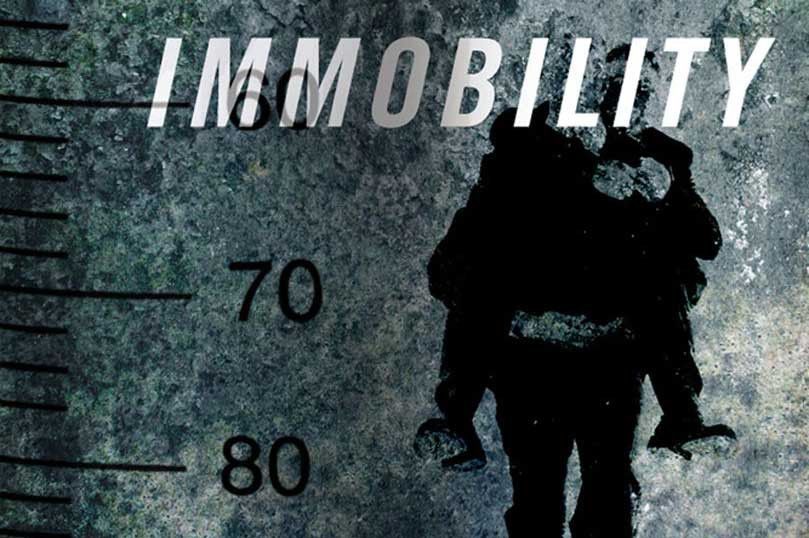
In Immobility, a man wakes up in a storage tank, with flashes of images that might be memories. He doesn’t know who he is, or was, or where he is. All he has are vague memories of the world ending in a cataclysmic event he calls the “Kollaps.”
Evenson operates in the space of psychological thriller, toying with its tropes. Josef Horkai (our protagonist from the tank) doesn’t know if he can trust those around him, especially after they tell him he is paralyzed from the waist down with a life-threatening illness. He doesn’t know the ruin and desolation of what remains of the world. He doesn’t understand why he can withstand its environment while everyone else needs to be protected under layers and layers of hazmat armor. And Horkai doesn’t know if he can even trust himself, if the flashes he sees are memories, dreams from the tank, or delusions.
Drawing easy parallels to Cormac McCarthy’s The Road for the bulk of the protagonist’s trek through a world he almost remembers before disaster, Immobility is a take on morality plays. Yet instead evolves into a meditation on action, inaction, choice, and nihilism. Has humanity had its chance already? Why should we receive another? Tight, sparse syntax and a minimal level of sf pseudoscience jargon and close quarters on-foot journeys directly evoke McCarthy’s Pulitzer winning work.
The novel’s endgame plays out like the route decision of Shin Megami Tensei’s Chaos/Neutral/Law pathways, with Horkai at the center of it all, a choice with consequences he cannot foresee. Like SMT, characters that orbit Horkai in neat segments of his journey represent the potential philosophies with which Horkai can shape his world.
It’s in the psychological thriller vein where Immobility is at its weakest, offering standard turns that are there only to spice up the narrative and bring it more in line with the other genres it finds itself. Immobility offers some tantalizing questions (Is Horkai being betrayed? Who is telling the truth?) where the answers don’t matter all that much at the novel’s close. Given Immobility’s philosophic ruminations, could be Evenson’s goal.
Note: This post contains Amazon Affiliate links to the products mentioned. We can receive a commission based on sales made using these links. No publisher or author has paid for this review or coverage. All books are either purchased or borrowed from the library. For concerns or questions, view our privacy policy.