What I Read Last Month: October 2018
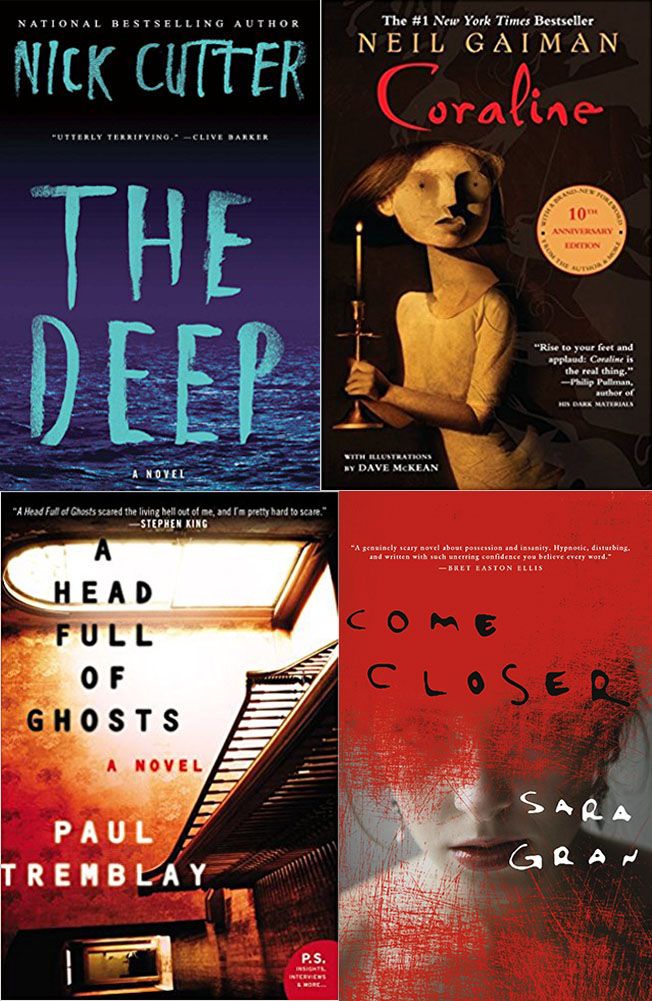
Halloween may be over, but the scares don’t have to end. If you’re looking for some horror book recommendations, here’s what I read during the spookiest month of the year. We’ve got underwater terror, demonic possessions, other mothers, and more.
 The Deep by Nick Cutter
The Deep is not very good. And I’m slightly upset I spent so much time reading it.
The Deep is a sci-fi horror novel, set in the present where a mysterious disease called the ‘gets (short for “forgets”) is ravaging the world. It causes disgusting skin lesions, but more critically causes victims to forget everything. At first they forget why they entered a room and then how to tie shoes, and soon enough they forget how to chew food and breathe. It always results in death.
But don’t worry about that too much, because the ‘gets is only the extremely specific inciting plot device and really has nothing to do with the rest of the book. Throughout, the disease functions as a convenient backstory for every single ancillary character. What tragic thing happened in their past? Loved one succumbed to the ‘gets. Every time.
It’s the same move The Walking Dead would pull when introducing a new character. Loved one died either via walker or died and turned into one. With the interacting character only able to offer an “I’m sorry” only to get a “Me too” in response. It’s fluff, filler, lazy, and trite. Unneeded.
Main character Luke, who is a veterinarian and whose son went missing, is going to see his super-genius estranged brother Clayton in a government research installation while he attempts to work out a cure for the ‘gets. Neither Luke or his brother are affected by the disease nor were there families, friends, or associates. It’s really all setup, and for long stretches of the novel the reader will forget all about the disease until someone mentions the reason they’re there again.
Cutter takes a while to even get to the meat of the story, quickly introducing and disposing of background characters that are nothing more than NPCs giving exposition dumps. The novel only gets going when Luke reaches the Trieste, a sub-aquatic station sprawled at the bottom of the Mariana Trench, the deepest part of the world. The station is basically a connected set of tubes and room, constantly shifting around because of the pressure of 8 miles of water on top of it. Like those hamster balls and tubes that they run through. Think Rapture from Bioshock, only making less sense and without the art deco or the objectivism.
Chapters are hilariously short, basically single scenes, and they almost always end in a cheap attempt at a cliffhanger to keep the reader going. Often these moments of tension are artificially inflated and are relieved in the very next sentence of the following chapter, unless Cutter is shifting to one of many flashbacks.
Everything revealed about Luke or his brother is realized through flashbacks, mostly about their awful childhood. Their mother was mean and also fat. Cutter will always take a moment to remind you of just how fat she was.
And not all that much is even learned in these flashbacks. Luke had an affinity for animals, hated his parents, and wanted his brother to like him. Clayton was a scientific prodigy, was distant, cold, and a bit of a prick. That’s it. Both are so bland and flat that I forgot Clayton’s name three times while writing this. The flashbacks are generally so forced that the major “twist” near the end of the novel literally has a flashback injected into Luke via some kind of magical science syringe and gives him information he didn’t know at the perfect moment.
Luke misses his ex-wife and son who went missing under his supervision. He’s a veterinarian. Did I mention that? Because he is. He’s so much of a vet that Cutter quickly gives him a faithful dog companion almost immediately upon arriving at an underwater station. The dog only has slightly less characterization than the human characters.
Aside from that, I couldn’t tell you a single thing about Luke’s personality. For the majority of the story that’s not in flashbacks, and especially in the latter half of the novel he’s reduced to shouting “Oh god no!” in ever-increasing volume in response to ever-increasing body horrors he’s forced to witness.
A lot of that body horror is actually one of the better aspects of the book. Some of it is deeply revolting, and therefore effective. But at a certain point it just becomes a series of images that are meant to shock and disgust, and otherwise serve no purpose.
One of the strangest series of chapters sees Luke go through the journal of a dead scientist from the station. His entries chronicle his declining sanity, but Cutter writes this in such a utilitarian fashion that his sanity only breaks when he doesn’t have information he needs to relay cleanly. It’s laughable when the scientist becomes something so totally inhuman, his living quarters turned into a space inhospitable and destroyed, his consciousness shattered. Yet he still is able to keep a fairly neat diary. It’s absolutely silly.
I spent way too much time reading The Deep but now hopefully I can keep you from that same fate. The interesting body horror is not nearly enough to make the slog worth it.
Coraline by Neil Gaiman
After The Deep I had to have a guaranteed breath of fresh air. Neil Gaiman is my favorite writer, but I have not read his entire bibliography yet. Often it feels like I read a Gaiman novel exactly when I need it most.
Coraline perhaps Gaiman’s most famous work (though that’s a bit like calling a Beatles song their most famous), has the distinction of being a truly original fairy tale. Coraline Jones, a 21st century “Alice” if Alice was a resourceful, even-tempered adventurer, is bored in her flat on a rainy day. Her parents are busy, her strange elderly neighbors have nothing to say. Aside from calling her Caroline despite Coraline’s polite but firm corrections.
Soon Coraline explores inside a locked door that was supposed to lead to nowhere. Instead she discovers another apartment, much like her own, inhabited by an other mother and an other father with large black buttons for eyes. And they say they love Coraline very much.
Gaiman is the master of infusing worlds with magic and Coraline perfectly supports that. His prose always sings and makes you believe you’re going to see something ethereal when you open a door, turn a corner, or turn a page. He also always finds joy and hope in the darkest of corners and the bleakest of passageways. Gaiman’s comedy is often matter-of-fact and functions as a way to highlight and then accept the absurd and weird. Coraline often plays scenarios straight in the face of mouse choruses and vaudeville shows with dog audiences.
And while known as a novel for younger readers, there is true terror in the visage of the other mother, and in her plot to keep Coraline all to herself. This tugs on an all-too genuine childhood fear of a loss of freedom. If you’re familiar with the doll-like aesthetic of the Henry Selick stop-motion adaptation, Gaiman’s descriptions of the other mother might be a shock. Here the button eyes are imposing and masking, a black mirror, a void, a slip of the unknowable leaking out. The recreation and distortion of Coraline’s home, shrouded in dense fog, is an attack on the familiar. The other mother wants to subvert Coraline’s sense of reality, to make her question what she knows. Absolutely chilling.
But Coraline is self-assured, even when she’s frightened and even, seemingly contradictory, in moments of doubt. She wields bravery like a sword, drawing it when she needs it most, often to help someone other than herself. Coraline is a protagonist that is a delight to root for, a character you’d want on your side too.
Read Coraline. Read Coraline again if you’re already read it. Give Coraline to a younger sibling, or cousin, or niece/nephew. It is a wonderful story that, like all fairy tales, will most assuredly stand the test of time.
 Come Closer by Sara Gran
Come Closer is an odd one. Originally published in 2003, it is a fairly straightforward possession story. A young career-focused woman starts hearing strange noises in her apartment. Her fiancé notices it too, but only when she’s home. Strange dreams ensue and she starts odd habits: kleptomania and promiscuity, along with urges outside of her normal personality.
It’s all basic demonic possession tropes, and the story unfolds about how you would expect. What’s odd is the book itself. My Kindle version claims it was re-published in 2012 as a sort of anniversary edition. Yet it’s rife with major errors and typos. Basic spelling problems, repeated words and phrases, the kind of mistakes you’d see in a very first, rough manuscript or advanced reader’s copy. Let alone a published commercial book, and it’s unimaginable for a re-print. A typo slipping into a published work is unfortunate, but understandable. It happens. These errors are consistent and jarring and it’s frankly amazing they slipped through a publisher’s editorial department.
The errors rip the reader out of the experience and mar what otherwise is an enjoyable novel that is, in some places, home to some excellent tension-building and striking images. In particular the connection between the protagonist’s childhood imaginary friend, her dreams, and her potential demonic harasser is intriguing to see unfold. It’s just odd that a re-published book, that managed to get a blurb from Brett Easton Ellis (another one of my favorite authors) is chockfull of easily avoided mistakes that hinder the reading experience.
A Head Full of Ghosts by Paul Tremblay
A Head Full of Ghosts is also a possession story, but Paul Tremblay takes a much different approach. The story is recollected by Meredith Barrett, Merry, as she relays her family’s story to a best-selling author writing a book about Merry’s experience as a young child.
Merry’s older sister Marjorie starts acting strange, scaring Merry with nighttime stories of death and destruction that Marjorie insists are true, or will become true. Marjorie claims that she is now remembering knowledge she always had, always existed, but didn’t know was there. Her parents seek psychological help, but this strains the family. Their father John is unemployed and is struggling to find work.
Marjorie is hearing voices, and needs to drown them out with her iPod volume cranked high. Her father plunges deeply into his Catholic faith to cope, to the dismay of his wife, and to the confusion of his kids.
A Head Full of Ghosts has three distinct chapter types. There are scenes in Merry’s adult perspective, where she talks and recollects with the author she’s giving her story to. Then there are the chapters where Merry takes us through the events in question, as she remembers them. These make up the bulk of the novel. And then sections are book-ended by chapters written as a horror blog that recaps and reviews the reality TV show that chronicled the family’s struggle to help Marjorie, called The Possession. It’s all really meta and inter-textual, and pretty cool.
And the irony is not lost on me that I’m writing a blog about a book that includes a blog about a fictional TV show. There are too many layers going on right now.
For these sections, think of Zampano from House of Leaves, where he writes extended academic treatises analyzing the non-existent documentary The Navidson Record. Here Tremblay does something similar, but takes that narrative structure and moves it into a blog, written by a quirky, horror-obsessed millennial who references everything from The Exorcist to (funnily enough) Come Closer. There chapters would be even more effective if Karen, the blogger, didn’t also reference House of Leaves. This shatters the illusion and is almost too sly for it’s own good. A reader already familiar with the ergodic novel from Mark Z. Danielewski already can see the parallels. It lessens the impact. Almost as if Tremblay really wanted to cite his sources for taking inspiration. Or to just really hammer the point home. And that inspiration is already hinted, as a minor character is named Navidson.
A Head Full of Ghosts plays with demonic possession tropes, but in a much more self-aware way. It takes the concept of “is she really possessed or is it mental illness” by highlighting different characters’ motivations for the outcome. But also placing the whole story under the lens of a kid’s memory, the lens of the reality show And reconciling that same kid’s memory and her position after living through the filming of the show and watching it afterwards. This forces the reader to question much of the narrative, and causes the final reveals to land with a great deal of gravity behind them.
There should be more books titled after punk songs.