The Diary of a Serial Killer's Daughter by L.A. Detwiler Review

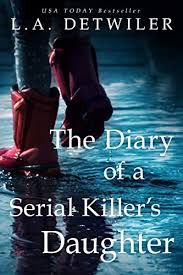
The Diary of a Serial Killer’s Daughter is presented quite literally. It is a thriller novel composed of diary entries written by Ruby Marlowe, the protagonist and narrator, a redheaded girl living in a single-parent household with her father. The novel, and recursively Ruby’s diary, spans multiple years, beginning when she is around eight. Ruby begins to notice her father’s strange habits: activity in the garage she is forbidden from going near, trips out of the house late at night, strange sights and sounds coming from that same garage.
The novel grapples with Ruby coming to terms with the realization that her father is a serial killer, her unyielding love for him despite anything he does, and what the impact of growing up in this blood-stained environment would do to a child already marked by tragedy.
The Diary of a Serial Killer’s Daughter gestures heavily, with a steel hammer, that Ruby is somewhere along the spectrum and has developmental disabilities. Ruby has obsessions with time, doing things precisely at times that end in seven. She is also fixated on the color red, a point that comes up in virtually every single diary entry, among other quirks. It is never outright stated exactly what difficulties, if any, Ruby has. This essentially forces the reader into the uncomfortable task of armchair diagnosing, as characters in Ruby’s orbit pelt her with pejoratives.
It is notoriously difficult to write from the perspective of children, especially when grappling in the realm of realistically-portrayed fiction. There is an inherent tension for the writer to make the prose believable; it has to come across as though a child would say it. Yet also the child has to convey crucially important pieces of information about the book’s world, characters, and plot that might seem implausible for a child to perceive, recognize, and make note of.
This is the biggest hurdle for the book’s early chapters and diary entries. These entries bounce back and forth between Ruby’s adoration of her father, her favorite activities and things she doesn’t like, childlike spelling mistakes, and then turns into accurate psychological examinations of those around her and uncovering her father’s twisted activities. Take this passage for example from early on:
“It’s been so long. I’d almost thought Daddy was done with his game in the garage because he hasn’t been out there in so long. Or I haven’t seen him if he was. Of course Mrs. Lansberry, my teacher, gives us so much homework this year. I am always so tired. Maybe I missed Daddy’s game– but I don’t think so. It’s like something switched off in Daddy, like he didn’t need the garage anymore.
And then suddenly he did.”
An eight year old could have written the beginning portion, maybe, until it’s clear that there’s information Ruby needs to convey for the plot to move forward.
If you are able to suspend your disbelief over the narration of those early chapters, within The Diary of a Serial Killer’s Daughter you can find moments of compelling inner turmoil and tension. The main project of the novel truly is exploring the question of what would happen to a child if they were raised by a serial killer. What does that do to their morality and sense of right and wrong? What does that do to their value of life and literal existentialism?
These explorations are the strongest moments in The Diary of a Serial Killer’s Daughter, especially as diary entries (whether intentionally reflecting Ruby’s personality or not) become repetitive and a touch formulaic. Part of this is caused by the diary form, so the prose, plot, and structure itself is wrapped up in Ruby’s head– and she has a one-track mind.
A sudden, left-field shift in the epilogue completely breaks this but instead of being welcome feels tacked on and foreign, and only serves to explain the themes that were already clear to anyone that held on for the novel’s brief trek into twisted family dynamics and secrets. The Diary of a Serial Killer’s Daughter would have been stronger if this afterward, cumbersome, out of place, and format-breaking, would have been chopped off entirely.
At the same time, one can’t help but wonder how this story could have been conveyed without the confines of the diary structure. Would those same fleeting moments of insight survive? Or would they too have been strung up and stuck like a pig?